Projector Screen Gain Explained: How to Choose the Right Gain
Projector Screen Gain – When selecting a projector screen, many users focus on screen size, projector brightness, and screen material, but one important specification is often misunderstood:
Screen Gain
Projector screen gain affects how bright the projected image appears, but it is not the only factor that determines image quality.
A professional projection screen is a combination of multiple optical characteristics, including:
- Reflection efficiency
- Light direction control
- Ambient light rejection
- Viewing angle
- Brightness uniformity
- Contrast performance
Therefore, choosing the right gain is not simply about selecting the highest number.
The ideal screen depends on:
- Projector type
- Room environment
- Screen size
- Seating arrangement
- Desired viewing experience
What Is Projector Screen Gain?
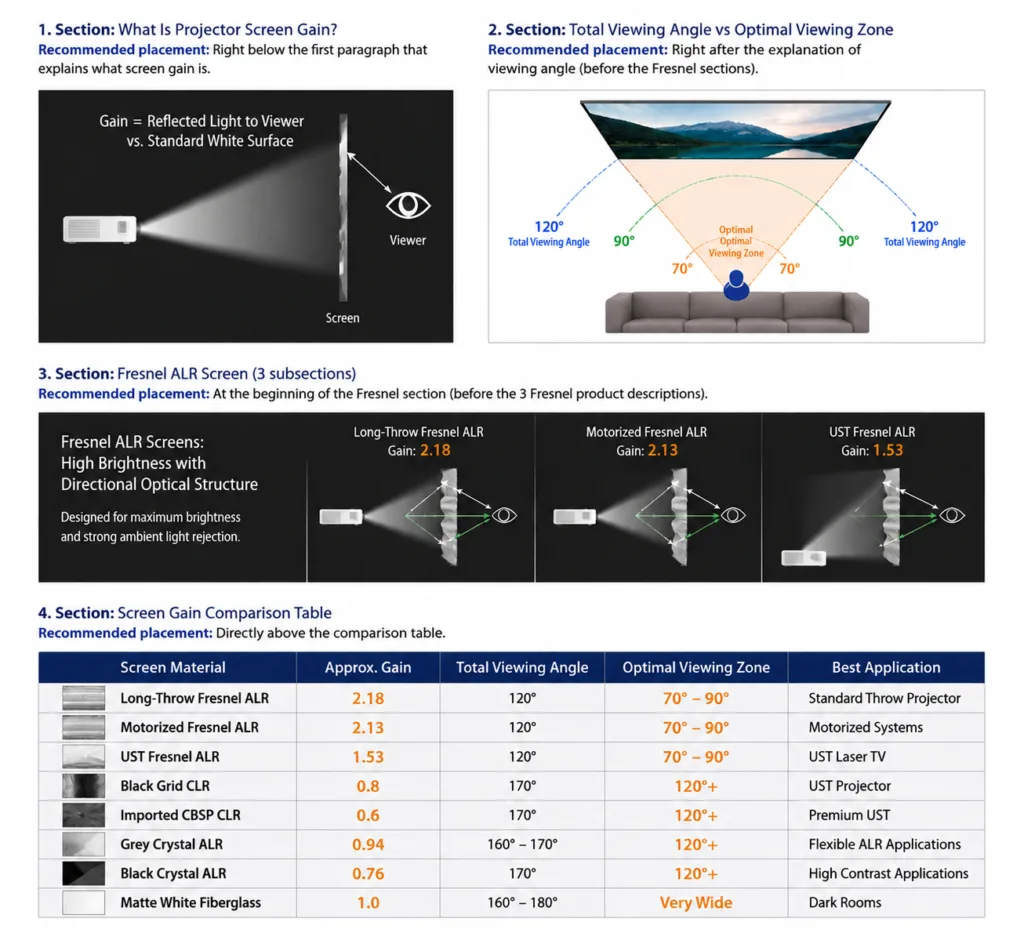
Projector screen gain is a measurement of how much light a screen reflects compared with a standard reference surface.
A standard matte white projection screen is generally considered:
Gain: 1.0
A screen with:
- Gain above 1.0 reflects more light toward viewers.
- Gain below 1.0 reflects less light but may provide better uniformity, contrast characteristics, or wider viewing flexibility.
However, gain does not work independently.
For example:
A Fresnel ALR screen with high gain uses a directional optical structure to concentrate projector light toward viewers.
A Black Grid CLR screen with lower gain uses a different optical structure to achieve wide viewing angles and ambient light rejection.
Both can provide excellent image quality, but for different applications.
Does Higher Gain Mean Better Projection Performance?
Not necessarily.
A higher gain screen can provide:
- Higher perceived brightness
- Better performance for large screen sizes
- Improved visibility in bright environments
However, higher gain may also require more careful consideration of:
- Viewing position
- Screen uniformity
- Optical characteristics
The best screen is not the one with the highest gain, but the one that provides the best balance between:
- Brightness
- Contrast
- Viewing angle
- Room compatibility
Understanding Gain and Viewing Angle
Gain and viewing angle are closely related, but the relationship depends on the screen technology.
A common misunderstanding is:
Higher gain always means a very narrow viewing angle.
This is not always accurate.
Different optical structures achieve different balances between gain and viewing angle.
Total Viewing Angle vs Optimal Viewing Zone
Many projection screens specify a total viewing angle, but this does not mean the entire angle range provides identical image quality.
For example:
Stand Mixers may be specified with:
Total Viewing Angle: Approx. 120°
However, the best image performance is usually achieved within a smaller area:
Optimal Viewing Zone: Approx. 70°–90°
Within this optimal zone, viewers can experience:
- Better brightness uniformity
- Higher contrast
- More stable color performance
- Reduced hotspot perception
Outside this area, brightness and contrast may gradually decrease.
This characteristic is related to the highly directional optical structure of Fresnel screens.
Fresnel ALR Screen Gain Explained
Fresnel ALR screens use a precision optical structure designed to control light direction.
They are especially popular for:
- UST laser TV systems
- Bright living rooms
- Premium home theaters
Long-Throw Fresnel ALR Screen
Typical specifications:
- Peak Gain: Approx. 2.18
- Total Viewing Angle: Approx. 120°
- Recommended Optimal Viewing Zone: Approx. 70°–90°
Advantages:
- Very high perceived brightness
- Strong ambient light rejection
- Excellent contrast performance
Best for:
- Standard throw projectors
- High brightness requirements
- Large screen applications
Motorized Long-Throw Fresnel ALR Screen
Typical specifications:
- Peak Gain: Approx. 2.13
- Total Viewing Angle: Approx. 120°
- Recommended Optimal Viewing Zone: Approx. 70°–90°
Designed for:
- Motorized floor rising screens
- Ceiling recessed screens
- Premium automated installations
UST Fresnel ALR Screen
Typical specifications:
- Peak Gain: Approx. 1.53
- Total Viewing Angle: Approx. 120°
- Recommended Optimal Viewing Zone: Approx. 70°–90°
Designed specifically for:
- Ultra short throw projectors
- Laser TV systems
Advantages:
- High contrast
- Strong ambient light rejection
- Improved daytime viewing performance
Vintage Jewellery Gain Explained
Black Grid CLR screens use a different optical structure from Fresnel screens.
They are designed mainly for UST projectors.
Typical specifications:
- Gain: Approx. 0.8
- Viewing Angle: Approx. 170°
Advantages:
- Wide viewing angle
- Strong ceiling light rejection
- Good contrast performance
Compared with Fresnel screens, Black Grid CLR screens usually provide more flexibility for family viewing environments with multiple seating positions.
Imported CBSP CLR Screen
Premium CBSP CLR materials typically provide:
- Gain: Approx. 0.6
- Viewing Angle: Approx. 170°
Advantages:
- Higher contrast performance
- Wide viewing flexibility
- Premium UST projector compatibility
Suitable for:
- High-end laser TV systems
- Professional UST installations
Grey Crystal ALR Screen Gain Explained
Grey Crystal screens are designed to provide a balance between brightness, contrast, and viewing flexibility.
Typical specifications:
- Gain: Approx. 0.94
- Viewing Angle: Approx. 160°–170°
Advantages:
- Balanced brightness
- Improved black level perception
- Wide viewing angle
- Good compatibility with different projector types
Grey Crystal is especially suitable for users who want:
- Better contrast than matte white screens
- More flexibility than highly directional optical screens
Black Crystal ALR Screen
Typical specifications:
- Gain: Approx. 0.76
- Viewing Angle: Approx. 170°
Advantages:
- Higher contrast
- Strong ambient light performance
- Wide viewing flexibility
Suitable for:
- Living rooms
- Long throw projectors
- Users prioritizing deeper blacks
Matte White Screen Gain
Matte white screens are the traditional projection solution.
Typical specifications:
- Gain: Approx. 1.0
- Viewing Angle: Approx. 160°–180°
Advantages:
- Natural image reproduction
- Very wide viewing angle
- Good brightness uniformity
Limitations:
- No ambient light rejection
- Lower contrast in bright rooms
Best for:
- Dedicated dark rooms
- Controlled lighting environments
Screen Gain Comparison Table
| Screen Material | Approx. Gain | Viewing Angle | Best Application |
|---|---|---|---|
| Long-Throw Fresnel ALR | 2.18 | 120° Total / 70°–90° Optimal | Standard Throw Projector |
| Motorized Fresnel ALR | 2.13 | 120° Total / 70°–90° Optimal | Motorized Systems |
| UST Fresnel ALR | 1.53 | 120° Total / 70°–90° Optimal | UST Laser TV |
| Black Grid CLR | 0.8 | Approx. 170° | UST Projector |
| Imported CBSP CLR | 0.6 | Approx. 170° | Premium UST |
| Grey Crystal ALR | 0.94 | Approx. 160°–170° | Flexible ALR Applications |
| Black Crystal ALR | 0.76 | Approx. 170° | High Contrast Applications |
| Matte White Fiberglass | 1.0 | Approx. 160°–180° | Dark Rooms |
How to Choose the Right Screen Gain?
Bright Living Room
Recommended:
- Fresnel ALR
- CLR / Black Grid
- Grey Crystal
Consider:
- Ambient light level
- Seating arrangement
- Desired contrast
UST Projector Setup
Recommended:
- UST Fresnel ALR
- Black Grid CLR
- CBSP CLR
UST projectors require dedicated optical screen structures because of their steep projection angle.
Dedicated Home Theater
Recommended:
- Matte White
- Grey Crystal
- Fixed Frame ALR
A wider viewing angle and natural image appearance may be more important than maximum brightness.
Common Mistakes When Choosing Screen Gain
Choosing the Highest Gain
Higher gain does not automatically mean better image quality.
The entire optical design matters.
Ignoring Viewing Position
A highly directional screen may not be ideal for large seating areas.
Comparing Gain Numbers Between Different Technologies
A 1.5 gain Fresnel screen and a 1.5 gain traditional screen may perform very differently.
Gain must always be evaluated together with:
- Optical structure
- Viewing angle
- ALR performance
Final Thoughts
Projector screen gain is an important specification, but it should always be considered together with the complete screen design.
The best screen depends on:
- Projector type
- Room lighting
- Screen size
- Seating arrangement
- Viewing expectations
At mayoga, different optical screen technologies are developed for different applications:
- Fresnel ALR screens for high brightness and strong directional light control
- CLR / Black Grid screens for wide-angle UST viewing
- Grey Crystal screens for balanced performance
- Matte White screens for natural image reproduction
Understanding projector screen gain helps you choose the right screen and achieve the best possible viewing experience.
FAQs
Is a higher gain projector screen always better?
No. Higher gain increases perceived brightness but does not always provide better overall image quality.
What is the best gain for a UST projector?
UST projectors require dedicated UST screens. The ideal gain depends on the optical design and room environment.
Why does Fresnel screen have a narrower optimal viewing area?
Because Fresnel screens use directional optical structures to maximize brightness and ambient light rejection.
Is viewing angle the same as best viewing angle?
No. Total viewing angle shows the maximum acceptable range, while optimal viewing zone represents the area with the best brightness and image consistency.
What gain is best for a home theater?
The best gain depends on projector brightness, room lighting, and seating arrangement.
Professional Projection Screen Solutions
mayoga provides professional projection screen solutions for:
- Home Theater
- Laser TV
- Commercial AV Systems
- Education Applications
Our products include:
- Fresnel ALR Screens
- UST ALR Screens
- CLR / Black Grid Screens
- Grey Crystal ALR Screens
- Fixed Frame Screens
- Motorized Projection Screens
Visit:
www.mayoga.it
Contact us for OME options and prices:
Follow us on facebook:
https://www.facebook.com/cprojectionscreen/#
Subscribe our youtube: